
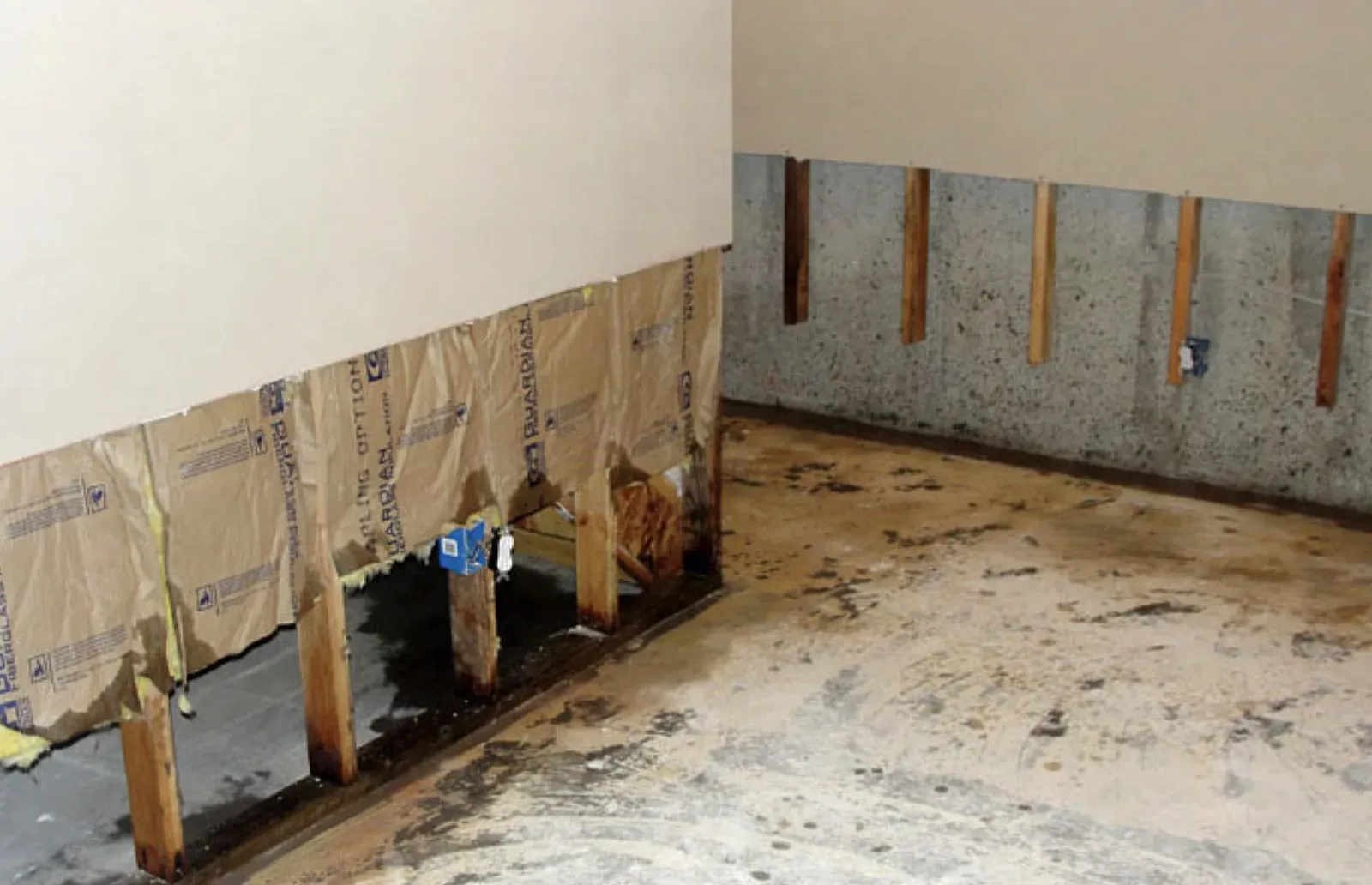
Signs you need this
- • A brown or yellow ring on the ceiling, or a ceiling that sags and feels soft or spongy underfoot from above.
- • A wall that bubbles, bulges, or crumbles at the baseboard after a leak, or a musty smell that will not clear.
- • Nail pops, tape seams lifting, or paint blistering along a run where water tracked behind the board.
Providence Premier Drywall repairs ceilings and walls damaged by leaks, burst pipes, and flooding. We find where the water came from, remove the board that is compromised, dry and check the framing behind it, and replace and refinish so the repair matches the surrounding surface. When mold is present behind the board, we address it before we close the wall.
Water damage is a cavity problem, not a surface problem
The stain on a Providence ceiling is the last thing to show and the least of it. By the time a brown ring appears, water has usually been in the assembly for days, wicking along the top of the board and into the joists. Drywall is gypsum wrapped in paper, and once the paper face pulls water it loses the bond that holds the panel flat and strong. That is why the repair is never judged by the size of the stain. A moisture meter runs across the surrounding board and into the framing to find where sound material actually starts, and that line, not the discoloration, is where the cut goes. Removing too little traps moisture behind new board; removing the right amount is the difference between a repair that lasts and one you call back about in a month.
Why old Providence housing sees so much of it
The city’s building stock is old and dense, and it takes water in ways newer construction does not. Century-old plumbing in triple-deckers and pre-1940 homes across the West End, Elmwood, and the East Side gives out at fittings and supply lines. New England freeze-thaw winters push ice dams under the eaves, and Narragansett Bay humidity keeps everything slow to dry. In a three-family, a second-floor supply leak becomes a first-floor ceiling stain, and the tenant who reports it is often a floor away from the cause. The water’s path gets diagnosed before anything opens, because fixing the ceiling without stopping the source just resets the clock.
Drying, mold, and closing the wall the right way
Before new board goes up, the cavity has to be dry and clean. The framing gets dried and confirmed to read below roughly 16 percent moisture, and the back of the removed board and the insulation get checked for mold, which can start within about 48 hours of the gypsum getting wet. Where moisture is a recurring risk, a bathroom wall, a below-grade ceiling, a spot under a chronic leak that has now been fixed, the replacement is moisture-resistant board such as USG Mold Tough or Gold Bond XP rather than standard gypsum. Then it gets taped and coated to a Level 4 for most walls or a Level 5 on a ceiling that will catch raking light, any lingering stain gets sealed with a stain-blocking primer so it cannot bleed back through the finish paint, and the texture gets matched. In pre-1978 homes the work is lead-safe under EPA RRP. Done this way, the repaired area is not a patch you learn to ignore; it is a ceiling or wall that reads as though nothing happened.
Materials & standards
Products & materials we use
- USG Mold Tough / PURPLE
- Gold Bond XP
- Stain-blocking / PVA primer
- Setting-type joint compound
Standards & codes we work to
- ASTM C840
- GA-216
- GA-214 finish Levels 4 and 5
- EPA RRP (pre-1978 lead-safe)
What the terms mean
- Moisture meter
- Paper-face failure
- Cavity drying
- Mold-resistant board
- Ghosting
- Raking light
- Level 4/5 finish
Options & variants
| Option | When it applies | Cost |
|---|---|---|
| Dry-and-refinish (surface only) | Board is stained but structurally sound and tests dry | Lowest scope |
| Cut-out and replace section | Paper face is compromised or the board is soft | Moderate, depends on area |
| Full ceiling or wall replacement | Widespread saturation or sagging | Largest scope, may include insulation |
What affects cost
- • How much board is actually wet, since a moisture meter, not the visible stain, sets the real boundary.
- • Whether the framing or insulation behind the board is saturated and needs drying or replacing.
- • Whether mold has started and needs treatment before closing up.
- • Ceiling versus wall: ceilings are overhead work and finish to a higher scrutiny under light.
- • Texture matching, and whether the whole ceiling needs to be recoated so the repair does not read as a patch.
What to expect
- 1
Call and describe the damage
You describe the leak and the stain, and we tell you whether it is urgent and what to do in the meantime.
- 2
On-site diagnosis
We find the water source, working with a plumber if needed, and moisture-meter the surrounding board and framing to map the real wet area.
- 3
Contain and cut back
We contain dust, protect the room, and cut back to sound, dry board.
- 4
Dry and check for mold
We dry the cavity, confirm the framing reads below about 16 percent moisture, and check for mold before anything gets covered.
- 5
Hang, tape, and finish
We hang new board, moisture-resistant where it belongs, tape, and coat to a Level 4 or 5 match.
- 6
Seal and texture-match
We seal any residual stain with a stain-blocking primer so it does not ghost back, match the texture, and prime paint-ready.
- 7
Clean up and walk-through
We clean up and walk the finished ceiling or wall with you.
When this isn’t the right call
- If the drywall is fine and only the paint is discolored, a painter may be all you need.
- If mold has spread well beyond the wet board, mold drywall replacement is the better fit.
- If the ceiling is old plaster over lath that is failing, plaster repair and conversion is the better fit.
Frequently asked questions
Can you just paint over the water stain? +
Only if the board is sound and fully dry. A stain-blocking primer stops the mark from bleeding through, but if the gypsum's paper face is compromised or the board is soft, painting traps the problem. We check with a moisture meter before deciding.
How do I know if there's mold behind the ceiling? +
Wet gypsum can grow mold within about 48 hours, out of sight in the cavity. When we open a water-damaged area we check the back of the board and the framing before we close it, and we treat or replace what is affected.
Do you work with my insurance company? +
Yes. We document the damage and the drywall scope for your adjuster and coordinate our portion so it lines up with the rest of the restoration.
Will the repaired ceiling match the rest? +
That is the goal. We match the texture and, on a ceiling where a patch would show under raking light, we often recoat the full surface so it reads as one uniform ceiling.
How fast can you come out for a sagging ceiling? +
We prioritize sagging or actively failing ceilings because an overhead collapse is a safety issue. Tell us it is sagging when you call.